Getting All Ramseyfied!

Financial Friday 1/31/20

So it’s been a while since the last Financial Friday. I apologize for that, but I’m back to doing them every Friday (or almost every Friday:). The last time we looked at a formula for being good stewards of our money from the book “Too Much: Living with Less in the Land of More” by Gary Johnson. In the book (which is one of THE best books on a balance biblical view of money) his formula is simple:

4 Principles (gratitude, contentment, trust, humility) + 4 Practices (debt-free living, saving, budgeting, giving = REAL PROFIT

And I talked about the first part of that equation last time. On the other side of the equation are the practices of debt-free living, saving, budgeting, and giving. I and a few others are getting schooled very well on those topics every Monday night in the Financial Peace University class that Tim and Heidi Caswell and doing a great job leading. It’s a great class that I wish I’d have taken 30 years ago if it existed. But it’s never too late. Most of you know of Dave Ramsey through his radio show, podcast, books, or if you attend First Church of Christ you’ve heard me talk about him. It’s just a great class and as I have been listening to his daily podcasts I am getting all “Ramseyfied.” I told my wife (who isn’t able to take the class with me this round) that the other day as we prepared to discuss our finances.

“What does that mean?” she asked me. I said it means getting mad at things like debt and not saving. It means doing everything possible to do those 4 practices above. You see, Ramsey’s principles aren’t really just his. And Gary Johnson’s formula isn’t just his. It’s all straight from the Bible and God’s plan for how to be faithful with money. But the thing about Dave Ramsey’s books and material and FPU is just the motivation couple with the knowledge that gets me “Ramseyfied.” And in the class what he calls Baby Steps (1-7) all involve those four practices above.

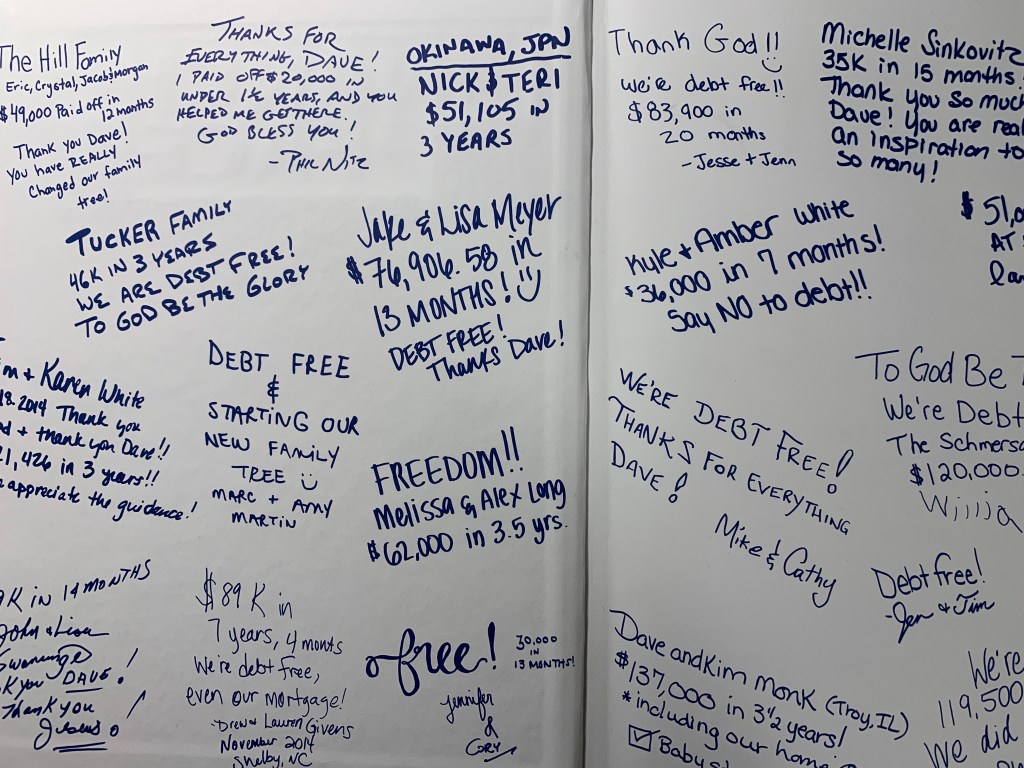
Nearly every day on Ramsey’s podcast he has families on the show who travel many miles to do their “debt free scream.” He does the show from Tennessee, but the other day there was a family from Macomb MI who travelled to TN just to do their debt free scream on his show. They tell their story of how following these simple, biblical principles Dave teaches allowed them to radically change their lives through getting rid of debt. The stories are pretty motivating and keep me focused on doing better with what God has entrusted to us to manage for His glory. So today I would really encourage you to subscribe to Dave Ramsey podcast, pick up one of his books, and take Financial Peace University at the earliest possible time. We’ll be offering it again next January for sure at our church. But don’t wait until then! It’s never too soon to get “Ramseyfied”!

2020!! What are we-the Jetsons?

As we look at 2019 in the rear view mirror, we see 2020 fast approaching through the windshield.  I heard someone comment the other day, “I sure hope that 2020 is a better year than 2019 was.”  I think for different reasons we all might say the same thing. 2019 (and really the whole 2010’s decade) was a mixed bag of good and bad.   Yesterday on CBS Sunday Morning (proclaimed by Bill Hill to be “The best thing on TV”—a statement I have always agreed with) comedian Jim Gaffigan said “2020! It can’t be 2020-what are we-The Jetsons?!”  Another statement I agree with.  It’s mindboggling that it’s 2020-yet here it is.   

I suppose people have always had similar thoughts every New Year: “1965! How can that be! Surely we’ll soon be able travel to the moon and back!”  I’m not sure that we face the crazy notion of the year 2020 with the same optimism and excitement for the future that most folks had in the mid 1960’s.  For the time, the 60’s were full of rapid acceleration and change.  And, yet, 1965 saw the birth of a Christmas tradition that nearly didn’t come to fruition because it seemed woefully out of step with the modern, fast paced days of 1965.   I am speaking of “A Charlie Brown Christmas.”  One of my favorite seasonal stories is how one of the best things TV ever produced nearly didn’t happen.  In fact animator Robert Smigel (of Saturday Night Live fame) called it “the greatest half-hour that American TV has ever produced.” 

I was thinking of this when I heard that the man responsible for bringing it to life, Lee Mendelson, died on Christmas Day (which seems somehow appropriate).   Mendelson was the last to die of the four people responsible for bringing the show to life: Charles Schulz, Vince Guaraldi who did all the music, and animator Bill Melendez.   Mendelson is the one who convinced the creator of the Peanuts, Charles Schulz, to do an animated Christmas special.  At first Schulz didn’t want to, but was persuaded.  And so “A Charlie Brown Christmas” first aired in 1965 with nearly half of all Americans watching it.  The next year when it aired nearly 65% of American homes tuned in.  It has aired every year ever since and is, by all accounts, a truly great show both for retaining the spirit and message of Christmas as well as for being a study in simple story telling.  But when it first aired, though viewers loved it, it was nearly ridiculed by TV critics because the animation was considered crude and the voices sounded like children.  This was because the voices were actually children.  There were a few demands Schulz had when he agreed to do the show.  One was that the voices had to actually be children and not adult actors sounding like children.  This is why the voices seem wooden and, well, childish.  Schulz also insisted that there be no laugh track.  He also demanded that the music be written and performed by San Francisco jazz legend Vince Guaraldi.  There has never been a better soundtrack of Christmas music every produced in my opinion.  

The other thing Schulz insisted on was to have Linus read the Christmas story right from the Bible in Luke 2.  Mendelson actually tried to get Schulz to not include that in the script for fear that it would never get greenlighted by the CBS executives.  Yet, as Mendelson recalled to the LA Times, “Charles Schulz just looked at me very coldly with his blue eyes and said, ‘If we don’t do it [tell the true meaning of Christmas], who will?’”   When it was screened the CBS executives sat in stony silence.  They thought it was too slow and too religious with the wrong music and the wrong message.  But it was too late to change anything and so they aired it.  How humbling must it have been to have been so wrong on everything! 

And now here we are some 53 years later and there is still the ever present wrangling between the real meaning of Christmas and the secular holiday it has been turned into.   I am so thankful that Charles Schulz was a Christian and insisted on keeping Christ in his Christmas show. And his question is a good one for us as we face yet another new year and decade.  When it comes to telling others about Christ: “If we don’t do it, who will?” 

May we tell the story and live it loudly this year.  2020! Time’s moving too fast! In the words of George Jetson: “JANE, STOP THIS CRAZY THING!”         Happy New Year

The Best Question Ever

Financial Friday 12/13/19

Last Friday we looked at the formula for financial success and faithfulness from Gary Johnson’s book, Too Much: Living With Less in The Land of More. If you’ll recall the equation looks like this:

4 Principles: Gratitude, Contentment, Trust, Humility PLUS 4 Practices: Debt Free, Savings, Budgeting, Giving EQUALS Real Profit

I’m going to take the next few weeks and discuss some of these elements. Today let’s tackle the one that I most often struggle with: Contentment. Over about the last 5 years I have been in a battle over being content with what I have. The specific issue is…well, it’s just that…I want a new TV. Specifically, I want a bigger one! So about 11 years ago we bought a new, pretty expensive Sony flat TV. Whereas they had some bigger ones back then, we bought a 40″ TV and this was considered big. I’m not even going to tell you what it cost, because compared to what they cost today it was an exorbitant amount. But I can truly say that we were justified in getting it for many reasons.

The problem with our current TV is this: It’s 40 inches. Because of the advances in them today we could fit a considerably bigger one in our entertainment center. And the price of good TVs has come down so much that we could get one. But here’s the thing-just because we could doesn’t mean we should. Ours still has a great picture. It’s HiDef though not the resolution today’s TVs have. I mean have you been to Costco or Best Buy and seen the new ones? Seriously, they are amazing. When I look at them I begin to become discontent and want one of them and think up reasons to get one. But, yet, when I sit in my house and watch something on our 10 year old, 40 inch Sony I think to myself “That’s a great picture! How awesome that a TV that’s nearly 11 years old has such a great picture and has caused us no trouble in all those years.” So contentment has been winning the new TV battle so far.

Now I am not criticizing anyone who has the latest 60 or 80 inch Samsung with 8k resolution (which probably cost half of what I paid for ours 10 years ago!). I am not always so victorious in the contentment department! It’s just that there is no reason in the world why we should spend a few hundred dollars on a new TV. Just because we could doesn’t mean we should.

The Bible of course has much to say about this. The apostle Paul wrote “I have learned the secret of being content.” The writer of Hebrews simply exhorts “be content with what you have.” Why does God want us to be content? Because our contentment leads to gain. 1 Timothy 6:6 reads “godliness with contentment is great gain.” That’s what God wants for us-great gain.

So the question is how do we know when, to use a 1st world problem example, we should buy a new TV, or a bigger house, or a new car, or whatever? I think the answer to that question is really pretty simple and viewed through this lens can usually be quickly deduced. Andy Stanley wrote a great book a few years ago in which he talks about “The Best Question Ever.” This question can be used in any situation, especially relating to our finances. The question is simply this: What is the wisest decision? What is the wisest decision. Hmmm. I have to say that figuring out what we should do is pretty simple for Christians. What is the wisest thing? The Bible is full of wisdom on many subjects. But also, I think that deep down we usually know what the wisest thing is.

So if it is pretty simple to know what is wisest then why do we so often do the exact opposite? There are a lot of reasons. We are pretty good at convincing ourselves of something even though deep down inside we know that it’s not the wisest, best thing to do. And our entire economy is geared to make us discontent so we’ll keep buying more stuff we don’t really need. Can you imagine what would happen if all of the sudden every American decided to practice contentment and not spend money as often or freely? The market would be in a free fall! So the question is “What is the wisest decision?” Not “what do I really want,” or “what do I really deserve,” or “what is impressive to neighbors or friends,” or any other reasons we come up with. Ask “what is the wisest decision?” Choosing contentment is the wisest decision far more often than we think it is. This I know. It’s pretty clear. Yet, too often we choose a path other than wisdom. And when we do that on a regular basis our financial situation deteriorates and the equation leads to loss not gain.

So a few years ago I got it in my head that I needed a bigger motorcycle. I had a great Honda VTX with a 1300cc engine. That’s a pretty big engine and I loved it. It fit me perfectly. But I came up with many, many reasons why I needed a bigger one. I had my eyes set on a very lightly used Victory with an 1800cc engine. The store had it at a discount because it was a couple years old, yet it had only a few hundred miles on it. It was a bargain! It was such a great deal! Probably never again for the rest of my life will I have the chance to get such a great bike at this price! I really couldn’t afford not to get it! And on and on went the “logic.”

I had cleared it with Lori and I was ready to do the deal and get it. Now almost never do dealers let you test ride motorcycles. It’s not like cars. And so I was ready to buy it when, at the last minute, the guy at the dealership asked me if I wanted to take it for a test ride. I said sure! So before I signed on the dotted line I took it for a spin. I’m glad I did because I absolutely HATED it. It just was so different from mine and handled so differently I couldn’t wait to get off it. Before I rode it I knew in my heart what the wise decision was–keep riding the bike I loved and that was paid off. But I was about to make an unwise decision that I would have regretted so much. I was saved from the costly consequences of an unwise purchase (thank you God!) and continued to ride my Honda for a couple more years before selling it. It really was a great bike. I had put about 40,000 miles on it and had nary a problem with it in 10 years. My decision to stop riding a couple years ago was the result of pondering the best question ever and deciding it was not the wisest for me to continue riding…but that’s a whole other story.

What is the wisest decision? I think it probably is the best question ever. I believe really getting honest about that question will help you practice contentment. It’s not always easy to do the wisest thing, but the question is pretty simple and, again, deep down we usually know the answer.

Only God Could Do That…

In this Christmas season I want to share with you the most incredible true story. It’s the story of Grover Norwood and Ulice Parker.  They were both Christians living in a small community in Texas.  Grover was a white man and Ulice was a black man.  This fact cannot be missed and is integral to the point of the story which is the only reason I point it out.  They attended different churches-Grover a more affluent predominantly white church and Ulice a largely black church.  Yet, the entire Parker and Norwood families were good friends. 

Over time Grover and Jill became concerned with the home that the Parkers were living in.  It was actually condemned with no hot water and many other issues.  Grover and Jill and their family, which included 4 year old daughter Joy, did what they could for the Parkers and considered them family.  Both Grover and his friend Ulice were deeply, deeply committed Christians.  But one night their faith and their friendship was put to the test.  Grover and his family were coming home from a ballgame.  It was dark and they needed to stop along the country road on the way home.  And for some unknown reason, little 4 year old Joy–the apple of Grover’s eye, jumped out of the car and ran into the road and was struck by an oncoming car.  The driver of that car assumed it was an animal but couldn’t really see since it was dark.  Joy was killed. Life was unimaginably hard for the Norwood family. But also for the driver of the car when he learned what had happened. The driver was Ulice Parker.

Though he was still in shock over losing Joy, when Grover heard that it was his friend Ulice his first thought was “I have to go to him, he has to be just devastated and scared to death.”   

In the days and weeks and months which followed, an incredible tapestry of love, grace and forgiveness was woven together as a shocked community gasped for air at the pathos of it all.  No charges were filed against Ulice at Grover’s insistence. Ulice should not have been driving at all, but Grover and Jill pleaded on behalf of Ulice for leniency.  Grover also insisted that the Parker family sit in the front row with the family at the funeral.  Ulice’s family didn’t have clothes they considered acceptable so Grover and his wife bought the family new clothes to attend the funeral.  As if that weren’t enough, in the days following the funeral Grover grew increasingly uneasy about the Parker’s living conditions.  So Grover rounded up a bunch of men from different churches and they totally remodeled and renovated the Parker’s house at no cost to the Parker family.  There is no explanation for it other than the reality of their faith. I love the way that Ulice’s pastor put it: “Only God, only God could do something like that.”

Around this time of year we are inundated with many saccharine sweet “Christmas” stories which really have nothing whatsoever to do with Jesus.  At the same time, this Christmas we are bombarded daily with grim and depressing news in our country.  As far as I’m concerned it matters not on which side of the aisle you sit politically, this is a dark time in our country as we face the reality of just how dysfunctional our government currently is.  The times we are living in and living through with the divisive rancor rival some of the darkest days in our country’s past.  

And then there is the church in America which too often seems to be taking its cues more from national politics than it does the Word of God.  And then there is the flood of stories of sexual abuse, abuse of power, financial corruption, and the like. We have seen such things bring down some of the most trusted pastors and church leaders—BOTH Catholic and Protestant.  

In my worse moments I am nearly paralyzed with despondency over the brokenness and spiritual vacuity of the last decade. And, yet, I need not look with pointed finger upon everyone else. For similar sin, brokenness, duplicity, anger, lust, and the like resides in my heart as well.

So how are we supposed to live out our faith in such times?  How can we-sinful sinners in a broken and sick world-make a difference as we are called to? How do we as a church community not succumb to opposite errors? On the one hand we are tempted to capitulate to the current cultural riptide and jettison clear biblical teaching. On the other hand, however, is the proclivity to use the Word of God and Christianity merely as a prop to support a weird sort of americanized civil Christianity which is really neither civil nor Christian.   

And so that’s why I thought of Grover and Ulice. In the video of this story, “The Heart of Texas,” Grover was asked how in the world he and Jill were able to extend such profound love and grace and compassion to the man who accidentally killed their little girl.  How is that even possible?   Grover pointed to a passage of scripture that has been his NorthStar guiding him throughout his entire life-2 Corinthians 6:3-10. He then read the passage, but he read it from an old translation by JB Phillips from the 60’s called “The New Testament in Modern English.” It is just a fantastic translation of the New Testament. I have it but, evidently, never read Phillips’ translation for this passage. It stopped me in my tracks when Grover read this passage.   Phillips’ translation of this passage from the apostle Paul is as relevant now as it was in the 60’s and the 1960’s:  

As far as we are concerned we do not wish to stand in anyone’s way, nor do we wish to bring discredit on the ministry God has given us. Indeed we want to prove ourselves genuine ministers of God whatever we have to go through—patient endurance of troubles or even disasters, being flogged or imprisoned; being mobbed, having to work like slaves, having to go without food or sleep.  All this we want to meet with sincerity, with insight and patience; by sheer kindness and Holy Spirit; with genuine love, speaking the plain truth, and living by the power of God. Our sole defense, our only weapon, is a life of integrity, whether we meet honor or dishonor, praise or blame. Called “imposters” we must be true, called “nobodies” we must be in the public eye. Never far from death, yet here we are alive, always “going through it” yet never “going under.”  We know sorrow, yet our joy is inextinguishable.  We have “nothing to bless ourselves with,” yet we bless many others with true riches. We are penniless, and yet in reality we have everything worth having.

            That’s just good stuff. It just hits at the heart of how we are called to live as Christians, in the first century and in the twenty-first century. My word, how much different would the world be if every Christian had this passage as their NorthStar? If it was good enough to guide Grover and Jill Norwood through such a horrible experience, it just might be enough to help us live authentic lives as Christians in our day and time.                          

You Could Use a Lifesaver

Financial Friday 12/6/19

“Hey, you look like you could use a lifesaver.”

This was the tagline for many years on commercials for LifeSavers. LifeSavers, one of America’s favorite candies (love the butter rum!), were created back in 1912 as a “summer candy” that wouldn’t melt in the heat of summer. Its name is derived from its shape, which happens to be a life preserver thrown to people who have fallen into the water. We see these life-rings on ships, beside swimming pools and hanging on lifeguard stands at the beach. In the commercials I remember from many years ago, there were usually two people, one of whom was facing some terrible situation (like missing the game winning shot or getting dumped by a girlfriend). So their friend would pull out a roll of the candy and say “you look like you could use a LifeSaver.”

There is no worse feeling of hopelessness and helplessness than drowning in debt or being swept out to sea by the riptide of financial problems. Unfortunately, in these situations we become desperate for someone to throw us a life saver. And so we are tempted to grasp at anything that looks like it might bring relief even if the life saver is more like a noose pulling us further adrift. I strongly believe in the old adage “If it sounds too good to be true, it usually is.” There is no easy, quick way to get out of debt. It takes time, wisdom, discipline, humility, hard work, and usually help from someone and something.

One the best books written recently to help with all aspects of financial management and especially debt is called “TOO MUCH: LIVING WITH LESS IN THE LAND OF MORE.” The book was written by my friend, Gary Johnson, who recently retired from pastoring The Creek church in Indianapolis. It’s just a great book and can be a real LifeSaver for you. I have several copies of the book for sale for $5. Just let me know you want one and I’ll get it to you.

In this book he boils down all the Bible has to say into a simple formula:

4 Principles: Gratitude, Contentment, Trust, Humility PLUS

4 Practices: Debt free, Savings, Budgeting, Giving = REAL PROFIT

Usually we think more in terms of the mechanics of money management: Saving, Spending, budgeting, eliminating debt. And, yet, the real battle is first having the right MIND about money. Things like gratitude, contentment, trust, humility. Right thinking about money leads to right actions with money. His contention in the book is that we as Christians simply need to live with less and spend less. We need to learn contentment in a nation built on and fueled by consumerism and discontentment. This is no easy thing to do. But contentment is truly the real lifesaver. And as the apostle Paul wrote, we need to learn the secret of being content in all situations.