
Financial Friday 2/7/20
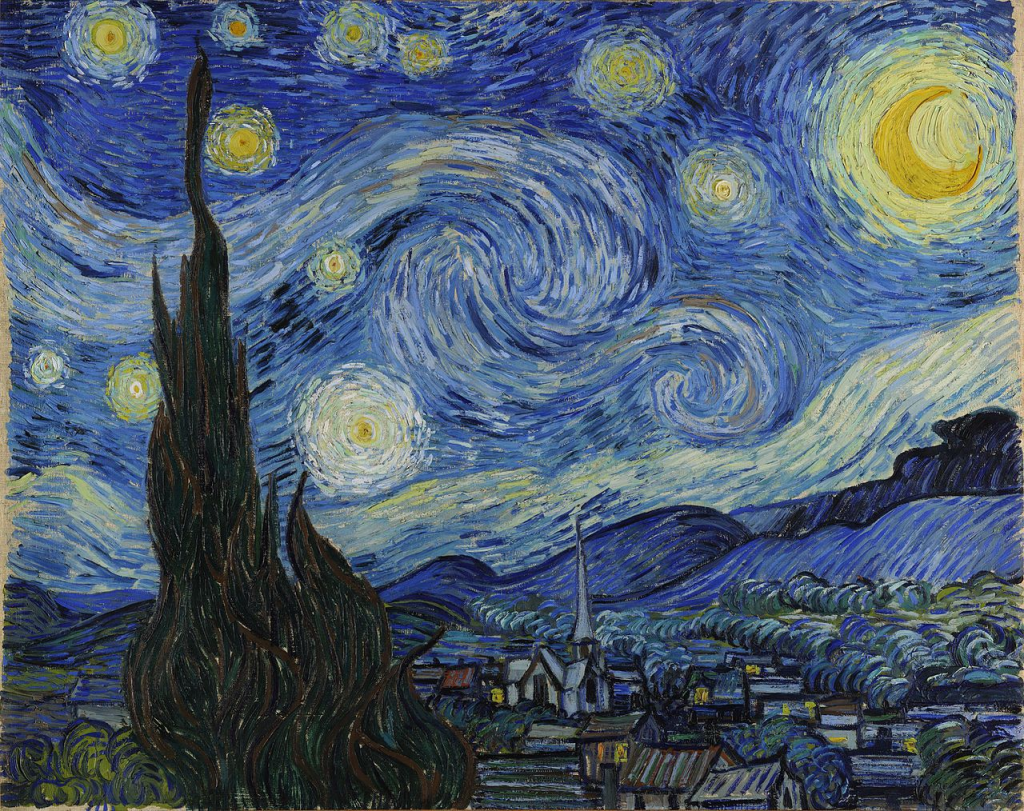
When most people think of Vincent van Gogh, they think about a crazy artist who cut his ear off and ended his own life at only 37. He did suffer from mental illness, he did cut off an ear, and he did take his own life. Yet there is so much more to understand about this Christian whose faith as well as disillusionment with institutional Christianity prominently affected his art. Though not successful as an artist during his lifetime, he is now rightly considered a genius whose painting style, use of color, and themes continue to inspire artists well beyond his own “post-impressionist” period of the mid to late 19th century. The above painting, “Starry Night,” is my favorite and is considered a masterpiece. Yet, as author Skye Jethani oints out in his excellent book, “The Divine Commodity,” there was much more going on in van Gogh’s paintings. He was brought up by a Christian family and aspired to be a missionary. His faith was not perfect, but he sincerely desired to follow Christ. However, he became deeply disillusioned by the institutional church of his day, and this is seen in his paintings, especially “Starry Night.”
If you look closely at the painting above you can see that Van Gogh’s use of color is amazing. Particularly the yellow that he uses for the stars and the lights from the buildings below. This yellow color, for him, represented God and goodness and holiness. So the stars and the lights in the village below the night sky are painted with this brilliant yellow light. This yellow light floods out of all the buildings, except for one–the church. If you look closely you’ll see that the windows of the church are all dark. This was Van Gogh’s commentary on the cold, sterile, hypocrisy of the institutional church. The factors in his life that led to this are many and varied but at the bottom of it all was his belief that the church and Christians did not reflect the Christ whose name they claimed. And who of us does not feel that same way at times–about others as well as ourselves. Too often, we are, at best, dim reflections of who Christ calls us to be.
So with this in mind, the painting below is one among many parodies of Starry Night. In this one, Ron English, replaces the French village with the architecture of consumerism with fast food joints and Hollywood icons. The church steeple is crowned with McDonald’s Golden Arches and King Kong straddles the roof. Interestingly, the church in the parody painting below is not dark, but has light coming from its windows. But it’s not the sacred yellow light of the stars. No. The light coming from the church windows is the same electric, fluorescent white light of all the other franchised McStores around it. This is the church of consumerism.
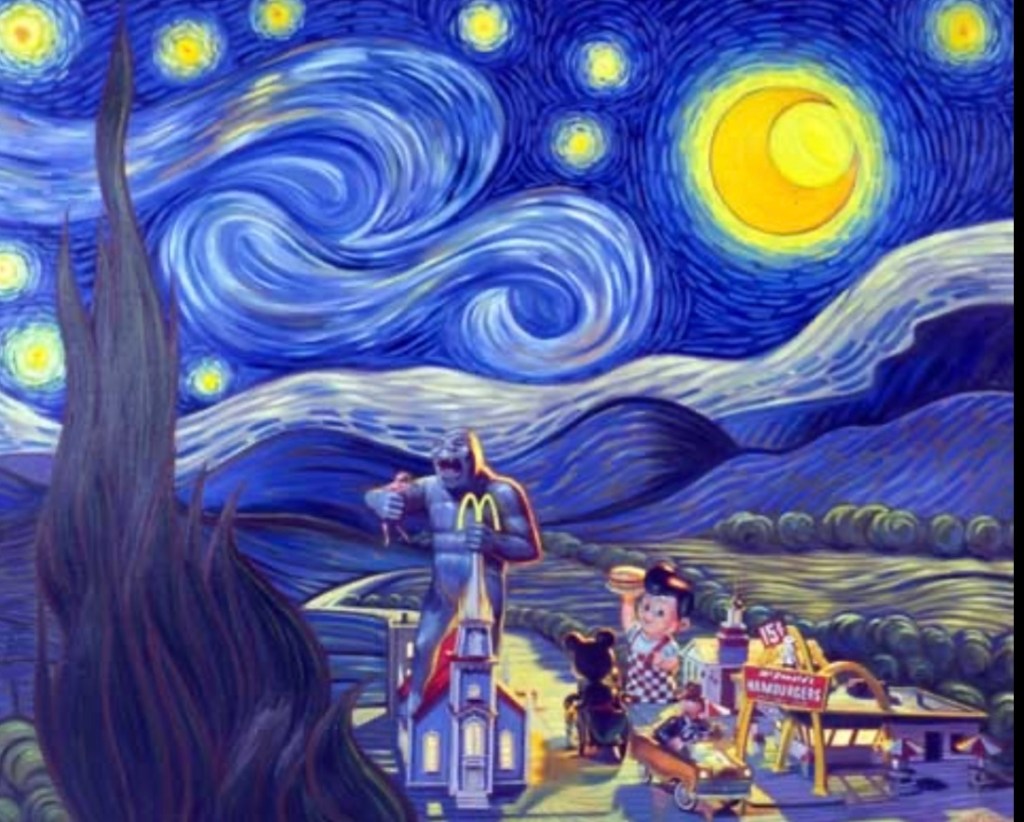
As Skye Jethani states in “The Divine Commodity:” “In 1889 Van Gogh’s struggle was with a church more focused on earthly power than heavenly glory.” English’s painting recognizes the church’s captivity to consumer values. As former chaplain of the United States Senate, Richard Halverson, once put it:
“In the beginning the church was a fellowship of men and women centered on living in Christ. Then the church moved to Greece, where it became a philosophy. Then it moved to Rome, where it became an institution. Next, it moved to Europe, where it became a culture. And, finally, [the church] moved to America, where it became an enterprise.”
Richard Halverson
Skye Jethani observes in a recent post in his devotional, With God Daily (withgoddaily.com): “…there is a difference between living in a consumer society and adopting a consumer worldview. Our faithful Christian predecessors lived within the Roman Empire, but their minds and hearts were not beholden to Caesar. Their ultimate citizenship and loyalty were not to Rome. Likewise, we must learn to exist in a consumer culture but not forfeit our souls at its alter.”
So what in the world does all this have to do with our personal finances on Financial Friday?
Simply this: As those who have been born and raised in a deeply consumeristic culture, Christians need to realize that we have been affected by this mentality as have our churches. It’s the air we breath. It’s all most of us have ever known. I love this country and believe that democracy and free market capitalism is capable of the greatest good as far as earthly governments go. But make no mistake-Jesus calls us as believers to be more concerned with a Kingdom economy marked by things like justice, contentment, true needs, generosity, and the like. Think about it: What would happen if every Christian (or every person) in America immediately become content with what we have. And this contentment caused us to reduce our spending by just half? If enough people did this, our economy which is predicated on consumers buying new stuff all the time would come to a screeching halt. All I am saying is that as Christians we need to really discern the difference between our true needs and our perceived wants. Though our advertising driven, consumer culture is all pervasive we need not be constantly seduced by it. Worshipping at the Church of Consumerism will keep us from true contentment and thoughtful, intentional biblical stewardship of what God gives to us.
 Chris Higgins